
Navigational Aids
The Jupiter Inlet District was created to maintain a navigable channel in the Loxahatchee River and the inlet, providing public access to these important waterways leading to the Atlantic Ocean.
Central to our mission the Jupiter Inlet District installed and maintains channel markers in the Central Embayment, North, Northwest and Southwest forks of the Loxahatchee River and the Jupiter Inlet in the interest of public safety in navigation. Quarterly inspections of all channel markers and navigational aids are conducted by the District. To report any missing or downed channel markers, please call (561) 746-2223.
Download a map of channel markers in the Central Embayment and the Boater's Guide below.
Jupiter Inlet District Channel Markers MapJupiter Inlet District Boater's Guide
Speed Zones for Boating Safety and Manatee Protection
Area waterways are divided into several speed regulation zones in order to increase boating safety and to minimize manatee injuries resulting from encounters with moving vessels. The Florida Fish and Wildlife Conservation Commission sets and enforces speed zones. Signs visible on the water mark the transitions between zones. To show all the zones at a glance, this map displays the different zones in varying colors.
Note that speed regulations for the lower Loxahatchee River change twice each year to reflect seasonal variation in manatee presence. From November 15 to March 31, Slow Speed, Minimum Wake (channel exempt) applies throughout the entire area outlined in solid red. For the remainder of the year, the rule is Slow Speed, Minimum Wake within 300 feet of shore (dashed red line). A turning "page" panel allows each advisory sign to display the correct seasonal message.

Tips to Help Protect Manatees & Sea Turtles
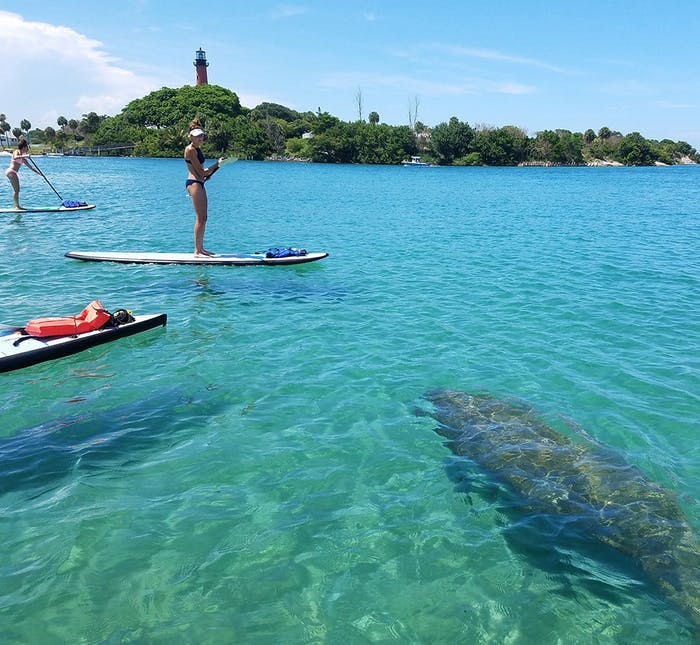
West Indian manatees are large, gray aquatic mammals. An adult manatee may be almost 10 feet long and weigh 800-1200 pounds. Manatees live in rivers, estuaries, saltwater bays, and canals, and have no natural enemies. However, many deaths result from collisions with watercraft. Manatees are protected under federal and Florida state law. It is unlawful to feed, touch, or disturb any manatee. State penalties are a maximum fine of $500 and/or imprisonment for up to 60 days. A federal penalty may be $100,000 and/or one year in prison.
The waters and beaches around Jupiter Inlet are also important habitat for sea turtles — ancient marine reptiles that spend most of their lives at sea but return to coastal areas to nest and forage. Five species of sea turtles are found in Florida waters, including loggerhead, green, hawksbill, Kemp’s ridley, and leatherback turtles. All of these are protected under federal and state law due to historical declines from fishing pressure, habitat loss, and other threats.
- Here are simple ways you can help protect local wildlife when boating:
- Be Alert: Always obey posted speed zone waterway signs including manatee caution zone signs; avoid manatee sanctuaries.
- Use a Spotter: Animals in the water can be hard to see. Keep a look out for signs of wildlife, like a snout breaking the water or a swirl or flat spot in the water caused by a swimming manatee's tail.
- Wear Polarized Sunglasses: Reduces glare and allows better through-water visibility.
- Go Slow for Those Below: Reducing boat speed gives you a better chance of seeing and avoiding wildlife. It also gives them time to get out of the way.
- Give Them Space: Stay in deep water channels as much as possible. Remain at least 50 feet away from manatees and stop your prop if you must go closer.
- Stow and Properly Dispose of Trash. Debris such as discarded plastic bags or six-pack holders are dangerous to marine wildlife. Properly discard or recycle monofilament line and fishhooks.
- Do Not Feed the Wildlife. It is against the law. Feeding, providing water or touching manatees may encourage them to approach people who might harm them.
- Be a Clean Boater: Keep your vessel in one of Florida’s Clean Marinas. This is a voluntary designation program with a proactive approach to environmental stewardship. Find and use the closest Clean Boater Program pump-out service.
For more information on local sea turtles, check out our partners at Loggerhead Marinelife Center.

